NIU legend George Bork passes away at 84
The two-sport titan from Mount Prospect, Illinois helped pioneer the adoption of the passing offense in college football.
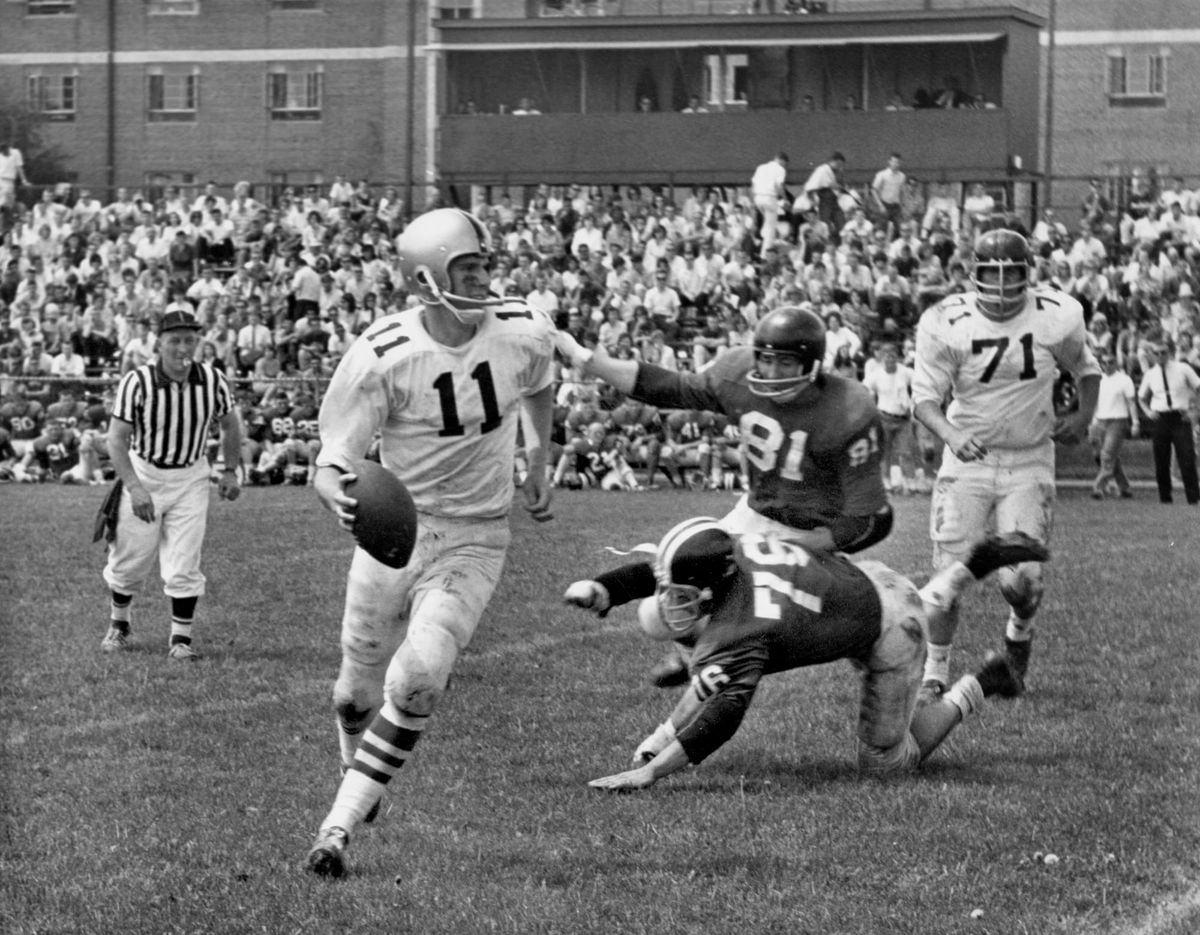
George Bork, an all-century Huskie in two sports who also became the first Northern Illinois player to be elected to the College Football Hall of Fame, passed away on Thursday morning at the age of 84.
Bork was born in Mount Prospect, Illinois, on February 8th, 1942, graduating from Arlington [IL] HS in 1959, where he gained interest from the University of Michigan as a basketball-only prospect before committing to play for NIU in both football and basketball in 1960.
While at NIU, Bork set the football record books ablaze and gained national notoriety, setting 16 NCAA passing records en route to a 10-0 regular season and claiming the Associated Press' 1963 Small College National Championship– while also becoming the first-ever quarterback at the NCAA level to toss for 3,000 yards in a single season.
That historic 1963 campaign, which saw him throw for 3,077 yards and 32 touchdowns, was enough to gain Heisman Trophy consideration, becoming the first NIU player to receive votes for the hallowed award.
Bork also earned first-team All-Interstate Intercollegate Athletic Conference, IIAC Player of the Year, and unanimous first-team AP, United Press International, Williamson Service, and NAIA All-American honors in back-to-back seasons, and gaining votes for AP and UPI "major" All-American honors in 1963 for his gridiron efforts.
In all, Bork finished his four-year career with 6,782 career air yards and 60 TDs, and still holds several NIU program records to this day, including career completion percentage (64 percent), single-season touchdown passes (32 in 1963), single-game completions (43 on Nov. 9, 1963 vs. Central Michigan) and single-game touchdowns (seven on Sept. 14, 1963 vs. Wisconsin-Whitewater).
Bork was also a well-renowned guard in basketball, scoring 1,114 points in three seasons for the Huskies. In his three-year cage career, Bork was tabbed to the Honorable Mention NAIA All-American team twice (1962-63) and claimed first-team IIAC and IAAC Player of the Year honors once. Bork was one of two Huskies to ever score 500+ points in a single season at the time of his departure, and left NIU as the program's third all-time leading career scorer, as well as its back-to-back season points leader (1961-62, 1962-63).
After graduation, Bork would pursue a professional football career. Size concerns (six-foot-one, 171 lbs.) resulted in Bork going undrafted by the National Football League, but he eventually found a spot in the Canadian Football League with the Montreal Alouettes, where he played parts of four seasons from 1964-67– though the official story of his tenure has unclear reporting due to the nature of the CFL import rules at the time.
Bork completed 51 percent of his career passes, gaining 2,593 passing yards, 15 total touchdowns (12 passing, three rushing) and 27 interceptions over seven pro campaigns between the Alouettes, Montreal Beavers (1967) and Chicago Owls (1968-70), while also logging nine career punts for a net average of 43.8 yards, including a long of 63 yards.
Bork retired into civilian life after his Chicago stint, becoming a teacher and high school sports coach and settling down with his wife, Merlin, and three children– Aubrey, Lindsey and Amy.
His individual legacy at NIU is immense; as the story goes, his popularity on campus was such that at one game in the 1963 season, the marching band's halftime show was dedicated to him, spelling out "B-O-R-K" while playing "You Gotta Be A Football Hero." Bork was inducted into NIU's Hall of Fame in 1983, and named to NIU's all-century team in both football and basketball, eventually getting his number 11 jersey retired in 1996 for football.
In a larger sense for the university, Bork is often credited with being the player who put NIU on the national map thanks to his electric performances in the "Blitz-T" offense. Construction for Huskie Stadium, which NIU still plays in today, started in 1964 after his departure and earned the nickname "The House That Bork Built". Bork's entry in the NIU Hall of Fame lists him as the "impetus" for Huskie Stadium, as well as the university's eventual ascent from the small college to university division of the NCAA in 1969 and their joining the Mid-American Conference in 1973.
Details regarding a celebration of Bork's life will be released at a later time, per NIU Athletics.
By the Belt thanks NIU Athletics, especially Dalton Ray, for their aid in clarifying statistics and providing media.