At the cost of college football, the 24-team Playoff is here
The pursuit of security above all will leave many in the wake of lapping waves.
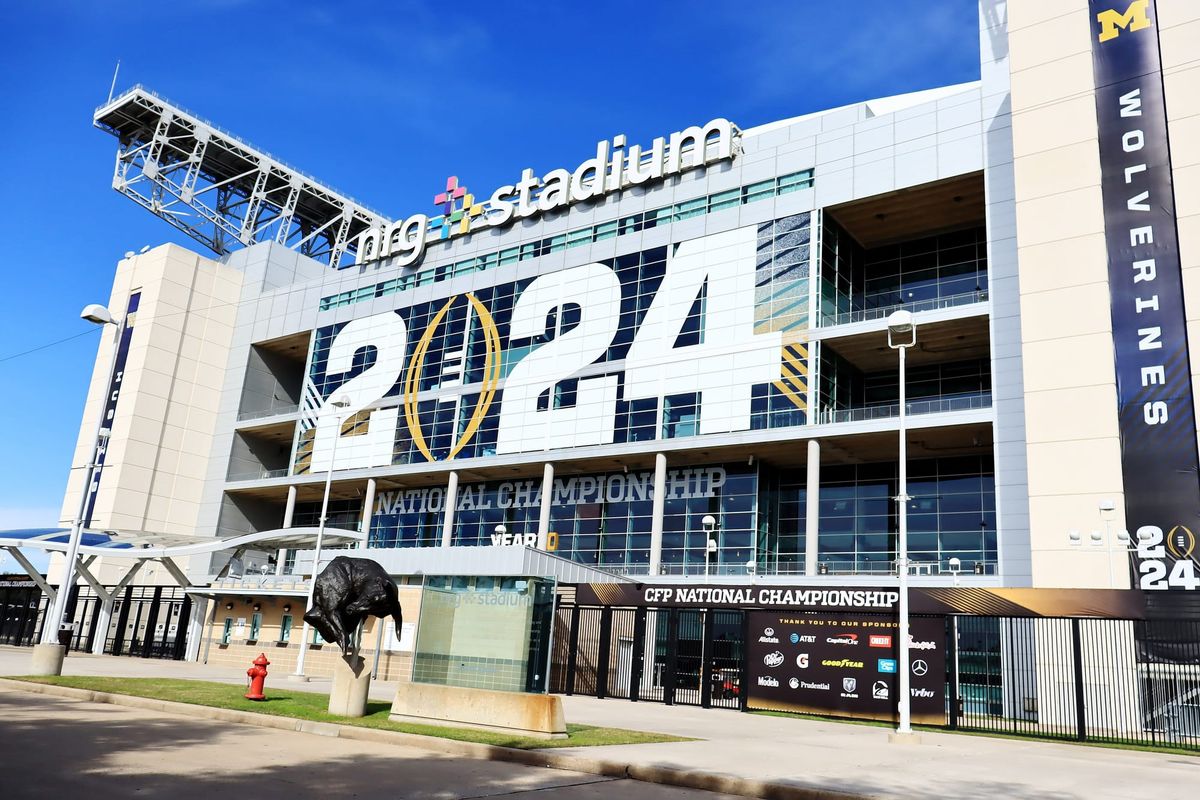
For nearly a decade-plus, the College Football Playoff, a solution to a problem of the sport's making with the Bowl Championship Series, has dictated the way fans contextualize the season.
Under the old BCS, a combination of computer metrics and outside polling (typically from coaches and media) would spit out a national title matchup and any at-large bids for New Year's Six bowl contests.
The system, towards its end, was lambasted for its cold logic, sticking too closely to potentially biased formulas and depriving the sporting public (as well as deserving teams) of truly deserving matchups.
This issue of impartiality was so important to the concept that the Associated Press pulled out of the BCS formula after Mack Brown, the then-head coach of Texas, successfully lobbied human pollsters to include his Longhorns over California in 2006 despite the computer metrics favoring the Golden Bears.
In the aftermath of the change came two infamous flops in 2011 (Alabama 21, LSU 0) and 2012 (Alabama 42, Notre Dame 14), fans lobbied for change. That change came after 2013, with the College Football Playoff taking over from the BCS in 2014.
The new four-team tournament would replace the computers with humans who meet in a room together, hashing out the 25 eligible teams in front of a television audience for consideration on a weekly basis. At the end, they would choose the four highest-ranked teams to play in a two-game tournament for the hardware.
This was a suitable arrangement most agreed with as long as the committee stayed consistent and precedent was followed.
Unfortunately, the process was flawed right from the start, with the list of talking points including:
- Big 12 co-champions TCU and Baylor both being jumped for Big Ten champion Ohio State (who went on to win the national title) in 2014 despite TCU being higher-ranked and Baylor similarly-ranked,
- Alabama breaking precedent by being added to the 2017 bracket over Big Ten champion Ohio State and undefeated American champion UCF despite not playing in the SEC Championship Game,
- Not forcing a first-round rematch between at-large SEC runners-up Georgia and SEC champion Alabama in 2021 – which eventually created an all-SEC title game Georgia won,
- Undefeated ACC champion Florida State getting snubbed due to an on-field injury in 2023, which broke a decade of precedence,
- Bellyaching about the seeding process of the first 12-team playoff in 2024, which in part saw Boise State and Arizona State get first-round byes before drawing Penn State and Texas, respectively, leading to drastic changes in 2025,
- A ninth-ranked Notre Dame getting jumped in the final rankings by 12th-ranked Miami [FL] program who did not qualify for the ACC championship game in 2026 despite neither team playing on championship weekend in 2026,
- and– in the same year– Tulane and JMU both securing automatic bids as mid-major conference champs while ACC champion Duke was frozen out for the aforementioned Hurricanes, leading to yet another reactive change for the 2027 campaign, which we'll discuss momentarily.
Alllllllll of that is to say college football in the last three decades or so has been an exercise in moving goalposts.
Thankfully for everyone involved, the solution to this problem of human error is finally here: make it bigger!
The powers that be have improved on what was a previously improved system (which improved a previously improved system, of course) by doubling its size and creating an all at-large field– except, of course, for automatic bids for Power champions (something which was never awarded in over a decade of the Playoff prior.) This move alone inflates Power representation by over double from the previous format while leaving effectively 70+ teams still fighting for one Group of Six champion spot.
Much like adding lanes to a highway to alleviate traffic, the idea is if you add more lanes, you can get more cars on the road and everyone can get into a lane and be happy.
(The same discussion with the same argumentative points is also being had surrounding the expansion of the NCAA Basketball Tournaments from 64 teams to 76, and has been met with similar ire.)
Except, that is never how it works.
That is not how driving works, that is not how human nature works and that is especially not how college football has ever worked. And we all know it. So, why does this keep being presented as a solution?
The simple answer is the illusion of security.
To wit, the American Football Coaches Association has voiced support for both Playoff expansion and the elimination of conference title games. The listed reasons were to open up access for teams while easing the burden on student-athletes and staff members, but if you don't take that at face value and consider their perspective for more than a minute, it's about the money.
Every coach at the Power level has incentives to reach their conference title game and the Playoff. If one eliminates the title games, you don't risk losing squandering an attainable goal in a one-off game against a potentially inferior opponent. You also don't risk a potential Playoff bid either. Going off regular-season performances keeps things tidy and is objectively easier to obtain. Same goes for making the Playoff. Whether you are seed #1 or seed #24, you're still in the Playoff, and that's another instant check in the bank.
It is a flawed-at-best assessment from a room of coaches who believe a Playoff ticket will assure they can keep their job longer by promising consistent shots at a chip. Fans are discerning enough to understand when expectations are not being met, and a first-round exit as a low double-digit seed in the Playoff will ultimately be no different than losing an unaffiliated bowl game. (If anything, it might be worse!)
Conference leadership felt a move was necessary for their own security as well. Memberships have infamously ballooned in recent years. The Big Ten now has 18 teams. The ACC somehow landed on 17. The SEC and Big XII each have 16. All of those leagues had 10-12 members at the turn of the century.
Member programs in Power conferences are spending tens of millions of dollars per year to field teams due to name-image-and-likeness agreements even before the now-quaint idea of covering scholarship and travel for over 100 players and dozens of coaches. In their eyes, the return on investment has to come to fruition at some point, and getting a 9-3 or 8-4 team in the Playoff as a low seed is one way to accomplish such a feat.
The talk of "more access" without strict guidelines on what that entails can be understood to mean more units (read: money) and slots for members of larger conferences to secure satisfaction on investment.
These conferences, now bloated and needing assurance they're going in the right direction, have been directly led on by the media companies who have major stakes invested in them.
ESPN and Fox have especially enjoyed the opportunity to stir the pot whenever possible.
ESPN was at the least indirectly responsible for separating the Big East basketball and football programs for the sake of leveraging carrier negotiations, with several defections going to ESPN-affiliated Power conferences. ESPN also injected itself into Big XII contract disputes by allowing Texas to create the Longhorn Network– and eventually encouraged Texas and rival Oklahoma to jump ship to the SEC for 2024, the timing of which coincided with the start of their exclusive deal with the conference for all football and basketball games.
FOX played a role here too, aiding the Big Ten in their pursuit of four of the PAC-12's big names in an effort to nationalize the Midwest brand– most notably USC and UCLA. The conference's 12th-hour negotiations with Oregon and Washington, helped by a promise of additional TV money, caved in the PAC-12's agreement-in-principle with Apple TV. ESPN and FOX would later aid the Big XII and ACC in acquiring six of the remaining eight PAC-12 teams to add to their respective portfolios.
Now, with several conferences– including the MAC– set to re-negotiate with ESPN and other media partners, there is a lot of unknown about how Playoff expansion and current viewing trends will impact future inventory.
Ratings for college football are sinking, down as much as 11 percent in places. The adaption of a 24-game bracket can, in part, be seen as a counter to secure more attractive early-season games for networks which would also give credence to the grander scheme of the College Football Playoff– especially if Power programs adopt the 10-game mandate with peer programs and wind down games with FCS and mid-major programs.
Expansion of the Playoff (and to a lesser extent, the NCAA Tournaments) is set to put ESPN in position to potentially sublease more games to other networks and make money from the new inventory– something they have already done in recent years.
The gamble is the viewing public loves football, and the more football you offer them, the more they'll watch, especially if it's high-stakes. If you can make it work, the money only goes up. Everybody wins.
All this talk is well and good as it regards the very top of the league; the rich get richer, the end. But further inspection as to the potential after-effects is the ultimate heart of the issue.
In their concerns over their national perception, Power conferences are single-handedly killing the shared regionalism of the sport. The fact the Big Ten and SEC can hold hundreds of programs and a dozen conferences hostage while they make a play for more money by threatening to leave and form their own league (with blackjack, and hookers!) is a brazen ploy which frankly, should have more pushback from fans, boosters and legislators alike for eroding the sanctity of the public mission of higher education.
If you like what you've read so far, please consider subscribing to help support our independent journalism here at By The Belt!
The 24-team Playoff is, indeed, a nasty plot against the spirit of collegiate athletics.
The current Bowl Season, which incorporates both the Playoff and the ancillary bowl games, is ran by ESPN Events, with the vast majority of games, locations and matchups under the company's control.
More Playoff inventory is good for ESPN's bottom dollar, but that inventory has to come from somewhere, and the likeliest target is Bowl Season itself, specifically lower-tier bowl games.
Unlike pro football, college football has a unique, unmistakable pageantry that is tied to home. Local identity is crucial to the aesthetic. In-person attendance, campus tradition and the community aspect are all major recruiting points regardless of myriad talk of NIL agreements and transfer portals.
In recent weeks, Disney bought out the contracts of their vice president of ESPN Events staff (which overlooks all of ESPN's bowl games and college basketball events) and their senior director of programming. This pair of buyouts signals a potential sea-change in how ESPN– and likely the College Football Playoff– see the future of the general landscape.
Big Ten commissioner Tony Pettiti, the biggest proponent for the 24-team format, discussed the potential adoption at a recent media availability, saying that a season cannot be considered a success unless a team qualifies for the Playoff– and that "it's not necessarily the best thing" to leave other programs to wait on "two teams" to figure out who's better, a reference to conference championships.
Even if the concept of a conference championship nowadays is considered a relic of the past which causes more issues than it solves in the modern set-up, it is still an important and essential part of the fan experience, and I think at the end of the day, that is ultimately what is at stake.
The idea of eliminating conference championship games to essentially absorb them into the College Football Playoff reeks of hyper-capitalization. It was not enough for the CFP to swallow the New Year's Six bowls into the racket; no, now they ask the college football world to accept that replacing the conference championship games– events which were formerly so important to have, that it left teams out of the Playoffs who did not play in one– with essentially a "play-in" round is not only acceptable, but even healthy for the sport.
There are 138 teams at the NCAA Football Bowl Subdivision level; realistically, there are about 15 teams who at any time could jump up and win the national title– even including Power levels. As a mid-major fan, I understand that my favorite team is very unlikely to reach that highest step. That's a simple reality I came to grips with years ago.
But this is also the reality for the good majority of the so-called "Power" teams. The difference between a lower-tier Power team and a higher-tier mid-major team is really not that large outside of monetary resources from television contracts. Not everyone has the resources or ability to make The Run. There are so many factors which go into a season you need to go right to even have the opportunity.
Flattening the expectations of a 12-game regular season to prop up a postseason invitational tournament seeded by arbitrary rulesets (which change year-over-year, and even during the year!) is simply not healthy for the overall long-term health of the sport.
Having a world where 60+ fanbases a year want to fire a coach because "the Playoff is all that matters" injects the sport with an unnecessary amount of stress and anxiety in a bottom-up fashion, and makes college football almost unpleasant to watch.
Asking fans, coaching staffs and boosters to consider such seasons as Bad because you did not meet an extremely subjective requirement to be considered "good enough" for national recognition is unsustainable– especially in a time where the transfer portal and on-hand resources have such a naked influence on direct team success.
Which, by the way, those same fans are being priced out of games due to inflating roster retention budgets, games are televised on increasingly expensive platforms which demand so much out of the customer in an already-nervy economic situation. Pushing this format against a fairly large amount of fan objection spits in the face of the people you are asking to support you.
This is why it is imperative there be exit ramps for other sorts of seasons to be considered successes. It's not only the Toledos and Texas States of the world which need these ramps; it's the Minnesotas and Pitts and Kentuckys of the world too. 8-4 and 9-3 are good seasons in the grand scheme of things. Rivalry trophies are still important. (Just ask PJ Fleck how it felt to reclaim the Little Brown Jug.) Winning the conference trophy, beating your rival(s) and/or making a marquee bowl game should still all be reasonable goals that point towards a good season.
These moves over the years have slowly eroded the idea of regional pride points for the sake of legitimizing a system which has not even been embraced whole-heartedly by the people being asked to partake in it.
Unfortunately, there are no easy solutions. In fact, I don't think there are solutions.
There are certainly no solutions when Power schools are outright attempting to dramatically overhaul Bowl Season– including potentially moving bowl games from the winter to the summer– so they never have to play non-Power schools in circumstances they can't control ever again.
Eliminating chances for such games early in the season due to tightening scheduling requirements by Power leagues, and potentially doing the same again in the postseason by cutting or drastically changing bowl games wounds the very sport the Playoff purportedly wants to elevate.
The discussion around re-bifurcation of the FBS teams, which has more or less already been socialized via the "Group of Six Playoff" discussion, also detracts from the student-athlete experience and deprives fans of the ability to root for a team on the same level as a Michigan or an Ohio State. From personal experience, it is an immense pride that my lowly school in the mid-Michigan plains can be on par with the bluebloods of college football on any given Saturday.
This issue was decided on a long time ago, when the concept of realignment was still a fresh and fun offseason fodder. Grant of Rights signed at the time were made with the idea an event of this nature could happen by 2027– and it has.
We are, in fact, in the middle of such change; James Madison kicked off potential wholesale realignment at the mid-major level earlier this week in part to put themselves in the best position for the Playoff.
Even now, the Protect College Sports Act's main provisions regarding expansion and level-wide media pools is being torn apart to serve higher interests– and will likely die in chamber as it currently stands, allowing these bold realignment moves to accelerate even further at all levels.
So, if the spirit of college football is dying and no one is around with a defibrillator, what do we do as a sporting public?
One solution is to simply stop watching. It's a bitter and acerbic suggestion, but a valid one. There's plenty of other sports to watch or hobbies to pick up. No one will judge you. I love watching race cars go around on ovals, I am not immune to exploration.
(Which does remind me: NASCAR had its own problems balancing out chasing a casual national audience with staying true to its die-hard regional roots in the midst of the 2008 economic crash. The France family's efforts to chase the dragon of national legitimacy caused a ratings nosedive so bad, not only is the sport still feeling its after-effects 20 years later, but the term "NASCAR Moment" is still used today for sports leagues recklessly overexerting their influence.)
Another is to wind down and follow it casually. If that's what calms the voices in your head and allows you to keep up with your school in a matter that's healthy, then so be it.
I get the feeling, however, that neither of the above options are ideal for a lot of us.(Especially if you've made it this far into the column.)
Our love for the sport is too genuine. We dare to perceive it as part of the intricate fabric of the human experience, as opposed to an avenue for extruding advertising money.
For us, there might not be a choice but to keep following. The players who don the colors, the communities who made you you... those still deserve your love and attention. Giving that up allows the people who see your passion as disposable to win.
And I guess... that makes us part of the problem too, doesn't it?