Matt Drinkall delivers passionate statements on proposed 24-team College Football Playoff
CMU's second-year leader took exception to various issues in the college footbal landscape on Tuesday morning.
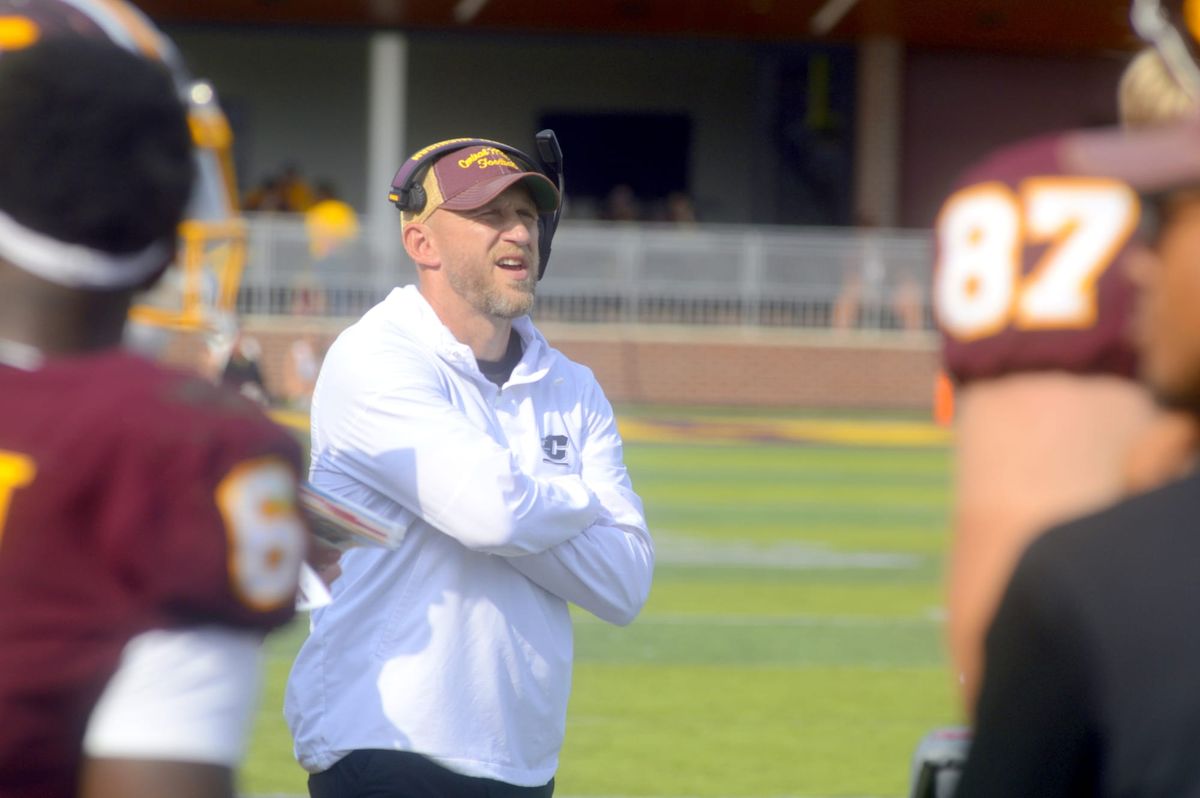
"How long would you like me to answer? I will be very honest with you about all of it, so how long would you like me to answer?"
That was Central Michigan head football coach Matt Drinkall's response when By The Belt asked him about the proposed 24-team College Football Playoff during Tuesday morning's media availability.
What followed would be an 11-minute exchange about the state of college athletics and the dynamics of media and corporate influence over the NCAA and its member conferences, ranging from the immediate (such as the adoption of a new postseason model and conference schedule changes) to the far-ranging (such fan tolerance of the sport's overexposure and long-term health of coaches and players affected.)
The bombshell portion of his comments, which grabbed the attention of the college football world at large, came about halfway through, when discussing the overall health of the sport:
[O]ne of my biggest concerns with it is I feel like everything is reactionary. All everything since COVID has just 100 percent been reactionary. No one has ever said, okay, well, if we do this, what does it look like 15 years from now? What does this look like 10 years from now? Is this in the best interest culturally of everyone? Or is it all just how do I save my ass and make the most money right this second right now? Which is what everyone's going to do.
Whoever has to sell TV spots or tickets at every school or promote a conference, they're not interested in what's good for the sport of football. They're not interested in what's good for young people coming up and they want to know what makes my job the most amount of money right now.
So everything since COVID, all reactionary. Conference realignment, eligibility, paying players, transfer policies. None of it's good. None of it is in the best interest of the student-athlete. None of it's in the best interest of the sport. It's just like everybody went nuts at once.
And it's just been a downward spiral that is nonstop until it's going to be a smoldering dumpster fire left when you like the Truffula trees and the Lorax. Like they're going to wring this sport out for every cent they can, as long as they can. and prostitute the sport for financial gain until people stop caring, just like they did with boxing back in the 20s and Major League Baseball back when they'd sell all these fields out. They're going to prostitute it as much as they can as possible until people stop caring.
It was the emotional crux of an argument Drinkall had clearly done some thinking about.
His comments cut to the ultimate heart of a matter many in the college sports fanbase have had uncomfortable conversations about in private settings: that those who fell in love with the tradition and pageantry of the college scene– even at Power conference programs– have increasingly been pushed out by changes made to extract as much wealth as possible for league decision-makers and the media networks they've partnered with.
"I think it's going to be it is going to be the last threshold that pushes a certain percentage of college football into the professional football realm forever," Drinkall said. "... If they move to this, it will separate Power Four football into its own separate thing of Division I football. I mean, whether you call everybody FBS or not, you can call them whatever you want. It's going to separate that group into a completely different league."
"[The expanded Playoff] is going to make the regular season absolutely matter less in several regards," Drinkall continued. "They're going to see multiple regular-season losses, which at some places like... the Cinderella seasons and seasons that go on that really help boost enrollment and engagement, ticket sales during the course of the season, you'll see all that stuff start to dwindle after the initial flow of the TV money."
When asked about the Group of Six Playoff being socialized in league circles as part of the broader suggestions for the future of the postseason, Drinkall was frank about the reality of such a prospect.
"[I]t's just FCS football, Drinkall said." [W]hat old FCS football was. There's the top tier and then there's the next tier. As soon as you start changing how postseason play works, that to me is a bigger change of levels of football than even scholarships or resources now."
Part of the proposed College Football Playoff re-formatting would be to reward four automatic bids to champions of the Power Four conferences with one spot to Group of Six teams– a concept which Drinkall also took umbrage with, equating it to "a carrot to dangle"– and arguing there would be no incentive for higher-resourced teams to challenge themselves when they realize the convenience of their positions.
"The conferences [Big Ten and SEC] obviously have demonstrated that they have more power as a conference than any NCAA institution does in a court of law, so the NCAA can't force anything," Drinkall quipped. "So as soon as all this money starts coming in... let me tell you something: if I was one of these schools and you were giving me a bunch of money and I just had to hand it out to other people for no reason, at some point I go 'how do I make it so I don't have to hand any of this away to you guys? Okay, I'm going to do that.'"
The Big Ten and SEC had similar influence over the creation of the Bowl Championship Series, as well the original College Football Playoff and the recent expansion of the NCAA Basketball Tournament– a still-raging topic of contention which Drinkall sees a parallel in.
"[J]ust like the NCAA basketball tournament," Drinkall said. "'Man, it's only one more play-in game.' Just kidding! Now we're letting everybody in. The whole thing's a tournament. Just gamble on all of it, promote all of it on TV. As long as we make money, who gives a shit? Who cares what happens to these kids?"
Drinkall's resume as a coach is unique; a former Iowa wide receiver under Kirk Ferentz in the early 2000s, Drinkall opted to start his career as an offensive line assistant at the NAIA level instead of Division I, climbing the ladder to eventually becoming a head coach at Kansas Wesleyan. From there, he went to Army West Point, serving as an assistant at various positions for Jeff Monken from 2019-2024 before being hired on at Central to replace Jim McElwain.
He often talks about idolizing former Iowa star Tavian Banks as a child, and brightens up when discussing his fellow coaches during weekly press conferences. (In one instance, he went on about Miami [FL] offensive line coach Alex Mirabal for a full five minutes.)
His acerbic tone on Tuesday, then, made for an interesting departure.
Drinkall sympathized with fanbases who feel uncertain about the sport, expressing frustration about how at the end of the day, most fans didn't want a lot of these changes and would rather it resemble the landscape they remember growing up with.
By the end of his comments, it was clear that he too was in that number– even in his position as a young, still-developing leader embedded within a structure he sees as hell-bent on hurting itself. With such background, then, his last comment was particularly poignant.
"[W]e get gaslit pretty hard into believing what we have to to justify changing what they to need to make money," Drinkall said. "So I get it a lot better now. Late to the party, but get it."
Central Michigan hosts the Miami RedHawks at Kelly/Shorts Stadium this Saturday at 1 p.m. Eastern time.