Should another Miami game move to TQL Stadium in the future?
Some look at the looming game against Cincy as the closing of a door, but could it instead be an opportunity?

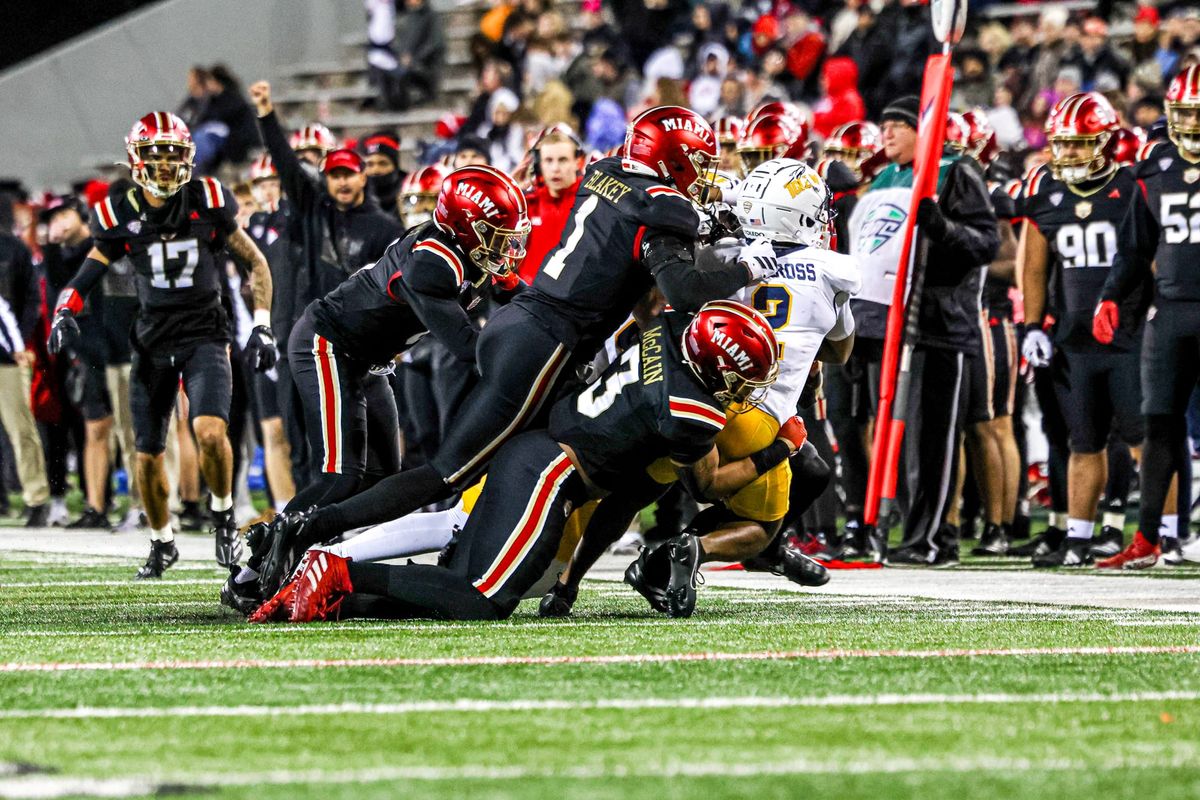
After months of speculation, Cincinnati announced a new location for the final final Victory Bell rivalry game for the foreseeable future, settling on nearby TQL Stadium.
In the short term, it is a significant attendance downgrade, with the venue change from Paycor Stadium (capacity ~65,000) to TQL Stadium resulting in a nearly 40k seat drop. (TQL Stadium can seat a max of 26,000-seat soccer stadium.) But there seems to be a lot of long-term optimism– at least as far as it goes for the venue's future as a host.
The game will serve as the first gridiron football contest at TQL Stadium, home of Major League Soccer's Cincinnati FC.
The Victory Bell appears to be just the beginning for FC Cincinnati and the Cincinnati Sports Commission (CSC). NBC 5 Cincinnati's Charlie Clifford reported on Tuesday afternoon FC Cincinnati is working with the CSC to bring more college football games to the venue. The venue, with the support of the city of Cincinnati, had lobbied for a postseason bowl for multiple years prior to the announcement of this game; the Victory Bell game could serve as an audition for future events at the five-year-old venue.
While the Victory Bell is gone after this year, a Miami RedHawks home game is a logical match for both sides. Although Yager Stadium and TQL Stadium have similar capacities, a game at TQL Stadium allows the RedHawks to maintain a strong presence in the city and increase ease of access for visiting fans.
There is no shortage of options for FC Cincinnati and the CSC to choose from. From a non-conference perspective, Western Kentucky and James Madison are the only two FBS non-conference home games currently on Miami’s future schedules. Both are valid options for a TQL Stadium home game. Western Kentucky is roughly 200 miles from Cincinnati and brings a solid road presence, while James Madison is a growing brand fresh off a College Football Playoff appearance who could bring outside attraction.
Nonetheless, the most lucrative option could be within the conference.
Midweek #MACtion is one of the most polarizing aspects of college football; many casual fans love the MAC’s niche on weeknight television, while some claim it kills fanbases and rivalries. No matter what side schools may take with the weeknight games, all have felt their effects. Miami is no different.
Miami still occasionally draws well for their weeknight games, with over 10,000 fans in attendance for all four of their November home games in 2023 and 2024. This is not the norm, however, as all four of Miami’s midweek home games drew fewer than 8,000 fans, with two seeing attendances below 6,000.
In 2016, Northern Illinois hosted Toledo at U.S. Cellular Field on the southside of Chicago, netting 10,180 attendees on a November weeknight. More recently, Eastern Michigan and Central Michigan announced their intention to play a two-year rivalry series at Ford Field in Detroit in an effort to get more attendance from nearby alumni in the area. FC Cincinnati’s push to enter the college football world could help Miami profit more from midweek #MACtion.
Moving one or two games out to TQL Stadium could be the most cost-effective way for FC Cincinnati and the Cincinnati Sports Commission to host a Miami home game, while giving Miami scheduling flexibility. The idea is counterintuitive but not unprecedented.
The 2026 Victory Bell is the end of an era for one of college football’s most enduring rivalries, but it could signify the start of a new one. The game serves as a test run for future showcases in the Queen City involving Miami, and could open the door to more scheduling flexibility should the university so desire it in an increasingly unpredictable college sports landscape.

![2026 MAC Football Week 4 Game Preview: Central Michigan Chippewas at Miami [FL] Hurricanes](https://storage.ghost.io/c/74/34/7434ccd7-5d86-4f2c-b98a-0f004224d6d6/content/images/size/w600/2026/09/fit-7.webp)